.png?width=300&height=36&name=Tradetraks%20Logo%20(1).png)
 By
·
3 minute read
By
·
3 minute read
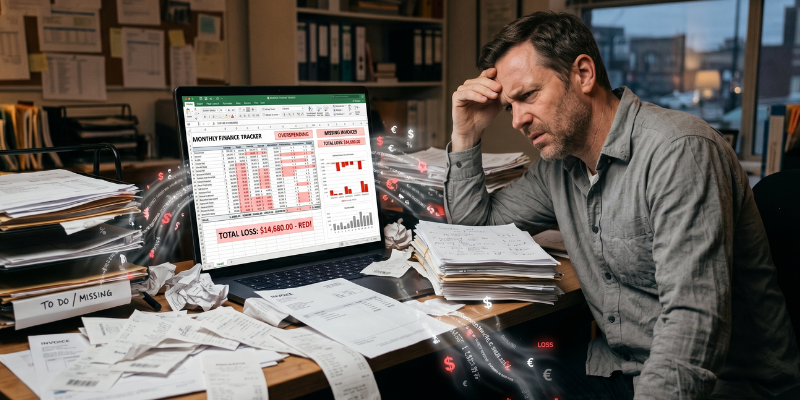
If you’re running your business on spreadsheets and paper, it probably feels normal. It works. It’s familiar. It’s cheap.
But here’s the problem most owners don’t realize until it’s too late: what feels “cheap” on the surface is often the most expensive system you can run.
Not because of the software itself, but because of everything it quietly breaks behind the scenes.
These are the hidden leaks. And they add up to thousands every single month.
The Illusion of Control
Spreadsheets give you a sense of control. Paper gives you something tangible. You can see it, touch it, adjust it.
But neither of them gives you real-time accuracy.
A spreadsheet is only as good as the last time someone updated it. A piece of paper is only as useful as the last person who wrote on it. The moment something changes in the field, your “system” is already outdated.
That gap between reality and your records is where money starts slipping away.
Missed updates turn into missed jobs. Outdated pricing turns into underbilled work. Miscommunication turns into costly mistakes.
You don’t notice it right away. But it’s happening every day.
Time Is Your Most Expensive Resource
Every time your team double-enters data, tracks down paperwork, or calls the office to confirm details, you’re paying for inefficiency.
Think about how many times this happens in a week:
- A technician calls in for job details
- Someone retypes handwritten notes into a spreadsheet
- An invoice gets delayed because information is missing
- A manager spends hours reconciling numbers that don’t match
Individually, these seem minor. Collectively, they are a massive drain.
If you add it up across your team, you’re not losing minutes. You’re losing dozens of hours every week. That’s payroll being spent on tasks that shouldn’t exist.
Errors That Quietly Kill Profit
Manual systems create manual errors. It’s unavoidable.
A wrong number in a spreadsheet. A misplaced decimal. A missed line item on an invoice. A lost piece of paper from the field.
These aren’t just small mistakes. They directly impact your bottom line.
Underbilling a job by even 5 percent can wipe out your profit margin. Multiply that across multiple jobs per month, and you’re suddenly looking at thousands in lost revenue.
The worst part is that most of these errors go unnoticed.
You don’t know what you didn’t charge for.
Lack of Visibility = Poor Decisions
You can’t fix what you can’t see.
When your data is scattered across spreadsheets, notebooks, emails, and job folders, getting a clear picture of your business becomes nearly impossible.
Questions that should have simple answers become time-consuming investigations:
- Which jobs are actually profitable?
- Where are we losing time?
- Which crews are most efficient?
- What’s our real cash flow this month?
Without accurate, real-time visibility, you’re making decisions based on outdated or incomplete information.
And that leads to one thing: bad decisions that cost money.
Communication Breakdowns in the Field
Paper and spreadsheets don’t communicate. People do. And people forget, mishear, and misunderstand.
When your field team and office aren’t connected in real time, things fall through the cracks:
- Jobs get scheduled incorrectly
- Materials are missing or wrong
- Scope changes aren’t documented
- Important notes never make it back to the office
Every breakdown creates friction. Every bit of friction slows your team down. And every delay eats into your margins.
Efficiency isn’t just about working harder. It’s about removing the obstacles that shouldn’t be there in the first place.
Scaling Becomes Impossible
What works for a small team quickly falls apart as you grow.
More jobs mean more paperwork. More employees mean more data. More complexity means more room for error.
Spreadsheets that once felt manageable become bloated and confusing. Paper systems become chaotic. Processes that used to take minutes start taking hours.
Growth should increase your profits. But without the right systems, it often increases your problems instead.
That’s when business owners hit a ceiling. Not because of lack of demand, but because their systems can’t handle the volume.
The Real Cost Isn’t Obvious
Here’s the truth: most business owners don’t feel these losses all at once.
They show up in small ways:
- A delayed invoice here
- A missed charge there
- A few extra hours of admin work
- A job that didn’t quite hit its margin
But when you stack them together over a month, the number becomes significant.
Over a year, it becomes staggering.
This is why so many businesses feel busy but not profitable. They’re working hard, but their systems are quietly working against them.
What a Better System Changes
When you move away from paper and spreadsheets, the goal isn’t just to “go digital.” It’s to eliminate the leaks.
A streamlined system gives you:
- Real-time updates from the field
- Accurate job costing and invoicing
- Clear visibility into performance and profitability
- Faster communication between teams
- Less manual work and fewer errors
It doesn’t just make things easier. It makes your business more profitable.
Because now, instead of reacting to problems after they happen, you can prevent them altogether.
The Bottom Line
Running your business on Excel and paper might feel like the safe choice. It’s familiar. It’s inexpensive. It’s what you’ve always done.
But the hidden costs tell a different story.
Every inefficiency, every error, every delay is quietly draining your profits.
And the longer you operate this way, the more it adds up.
The businesses that grow and scale successfully aren’t just working harder. They’re operating smarter with systems that support them instead of slowing them down.
If you’re serious about protecting your margins and increasing your profitability, it starts with taking a hard look at the tools you’re using every day.
Because what you don’t see might be what’s costing you the most.
If you’re looking for a way to eliminate these leaks and run a more efficient, profitable operation, platforms like Tradetraks are built specifically to help trades businesses simplify their systems, improve visibility, and keep more of the money they earn.
